



Your Operations Team Is Drowning in Manual Work - Here's Why Software Won't Save You
- 9 min read
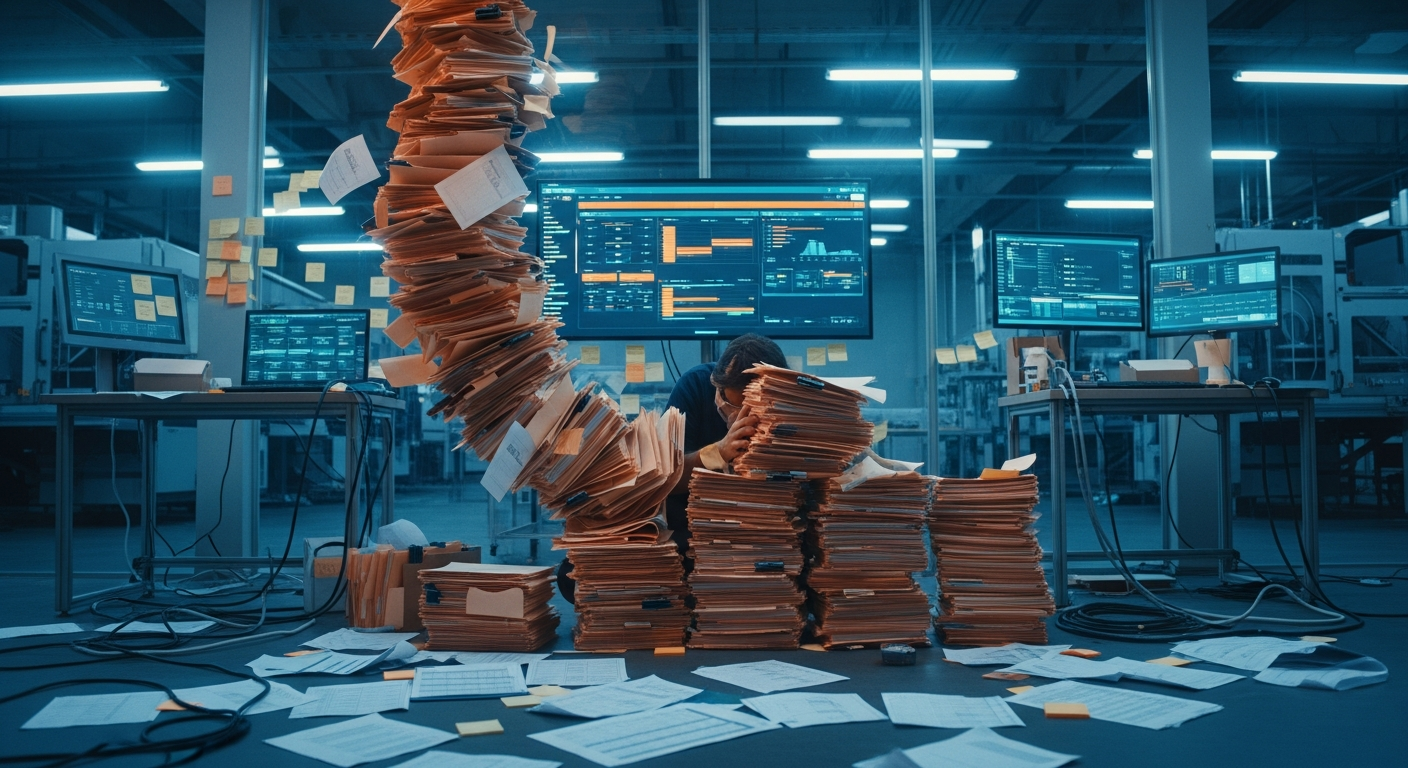
I got a call last week from an operations director at a mid-sized manufacturing company. They’ve got 50 people, five facilities, revenue around $8M, and they’re drowning.
“We need custom software,” they told me. “Our team spends four hours a day logging shipments, cross-referencing orders, pulling data from three different systems. We need a platform that connects everything.”
I listened. I asked questions. And then I said something they didn’t expect: “You probably don’t need software. You need systems first.”
They got quiet.
Here’s what I see play out constantly - with manufacturers, logistics operations, property management companies, anywhere that runs on coordination and data: a team is choking under manual work, so they assume the fix is a custom app. Sometimes that’s true. Most of the time, it’s not.
The real problem isn’t that they lack a platform. It’s that their processes are chaos. And you can’t code your way out of chaos.
The Difference Between Process Chaos and Software Problems
Let me separate these two things because they look the same from the outside.
Process chaos looks like this: Your team is doing the same work three times in three different tools. A salesperson sends you a quote that goes to the customer, then gets re-entered in your accounting system, then gets re-entered in your ops tracking system. Three times. Same data. Three people. Zero automation, just manual re-entry.
Or: Your warehouse team has a checklist on a spreadsheet. When they complete a checklist, they email it to operations. Someone else then manually keys those numbers into your business system. If the email got missed or the data got transposed - and it does - nobody knows until it’s time to ship.
Or: You have five different sources of truth. The CRM says one thing about the customer. The accounting system says another. The ops system says something else. Nobody agrees on what’s real because the sources don’t talk to each other and nobody has documented a system for which one wins when they disagree.
This is process chaos. It’s expensive, it’s slow, and it’s brutally manual.
Software problems, by contrast, are the opposite. Your systems and processes are solid. People know what’s supposed to happen. The workflow is clean. But you’re doing it in a way that doesn’t scale or that’s creating new friction as you grow.
Example: You’ve got a solid process for intake -> approval -> execution. It works. But it’s spread across email, Slack, spreadsheets, and a legacy system. The work is happening right, but the tools are fragmented. That’s a software problem.
Here’s the critical difference: with a software problem, you can build your way to a solution. With process chaos, building software doesn’t fix anything. It just automates the chaos.
What Happens When You Build Software on Broken Processes
I worked with a company in the last year that made this mistake.
They had a logistics operation - incoming shipments, quality checks, inventory management, fulfillment. Their team was doing roughly 30% more work than necessary because their process was a mess. Incoming shipments went to multiple people depending on the supplier. Quality checks used different criteria depending on who was doing them. Nobody knew what was actually in inventory because it was tracked three different ways.
When a customer complained, they’d spend hours reconstructing what actually happened.
They needed help. And their first instinct - totally reasonable - was “let’s build a platform that connects all our data.”
They hired someone to scope it out. Six weeks of conversations. The scope? $200k of custom development to build a system that would tie everything together.
I came in to review. Immediately: this is the wrong path.
We spent two weeks documenting the actual process. What actually happens from shipment receipt to fulfillment? Not what’s supposed to happen - what actually happens.
What we found: there was no consistent process. Different suppliers had different procedures. Different quality checkers had different standards. Different warehouse teams used different systems. The variation itself was the problem.
The software they thought they needed? It would have codified all that variation. You’d build a system that could accommodate all the different ways people were doing the work, and you’d be stuck with that mess forever.
Instead, we spent two weeks fixing the process. One intake procedure, not five. One quality standard, not four. One inventory system, not three.
Once that was standardized, their existing tools worked fine. They didn’t need custom software. They needed discipline.
It took two weeks and an operations consultant. Not six months and $200k.
The Test: Before You Write Code
Here’s how to know which category you’re in. Before you talk to a developer, before you budget for custom software, ask these questions:
1. Can you describe the process in a single flowchart that everyone agrees on?
Get your ops team, your management, your front-line people who do the work. Can they agree on what the process actually is? If the answer is “well, it depends” or “some teams do it this way but others do it that way,” that’s a process problem. No software fixes it until the process is standardized.
2. If you removed the software tools, could someone perform this process with paper and discipline?
I’m serious. If your process requires custom software to function, you’ve embedded complexity into the system itself rather than standardized your operations.
The best operations I’ve seen? They’d still work if you had to do it on paper and index cards. The software just makes it faster and less error-prone.
If your process breaks without the software tool, the process itself is fragile.
3. What percentage of the manual work is data entry that could be automated, vs. human judgment and decision-making?
Some work is irreducibly human. A quality inspector checking welds. A salesperson negotiating a contract. A customer service person solving a problem.
But a lot of operations work is pure data work - copying information from one system to another, keying data, querying information. That’s the stuff software actually solves.
If your team is drowning in manual work but 60% of it is judgment-based decision-making, no software saves you. You need to hire better people or train them better.
If 80% of it is data work, software might actually help.
4. Have you optimized the existing process before adding new tools?
I ask this because I’ve seen companies layer on software before they’ve tried to fix the process.
One client was spending 10 hours a day pulling reports from various systems and combining them into one master report that went to leadership. They immediately thought “we need software that does this automatically.”
But when I asked “why do you need this report?” nobody had a good answer. It was tradition. They’d always made this report.
We killed the report. Those 10 hours disappeared.
They never needed software. They needed someone to question why they were doing the work in the first place.
When Software Actually Is the Answer
To be clear: sometimes custom software is the right move. But you build it from a position of strength, not weakness.
This looks like: your process is standardized. Everyone agrees on how work flows. Your team understands the procedure, and they’re executing it consistently. But the volume is getting too high, or the tool complexity is getting unmanageable, or you’re losing competitive advantage because your competitors have better visibility into their operations.
That’s when you build. Not to create order from chaos, but to scale a solid operation.
A manufacturer with clean processes for intake, QC, fulfillment, shipping - once that’s rock-solid - can actually benefit from a system that tracks every unit through the pipeline, gives visibility, catches quality issues early, flags delays, predicts shipping dates.
But they could only build that right because the operations were already disciplined.
Software amplifies. It takes a good process and makes it faster, more visible, more leveraged. It takes a broken process and makes it faster at breaking, and more visible in its brokenness.
The Path Forward
If you’re sitting in chaos right now - your team is drowning in manual work, things slip through the cracks, nobody has a clear picture of what’s actually happening - here’s what to do before you talk to a developer:
Week 1: Document the actual process. Not the intended process. The real process. Get people to talk through what they actually do each day. Where do they check email? Where do they switch between tools? Where do they re-enter data?
Week 2: Find the variation. Where are there multiple ways of doing the same work? Why? Is the variation intentional or accidental? Does it need to exist?
Week 3: Standardize. Pick one way. Document it. Train people. Set expectations. Get discipline.
Week 4: Optimize. Now that it’s standardized, where’s the waste? What steps are unnecessary? What tools can be removed now that you’re not trying to accommodate seven different ways of doing the job?
Only after that - after the process is clean, standardized, and optimized - should you talk to someone about building software.
Most of the time, you won’t need to.
You’ll have found that your operational friction wasn’t a technology problem. It was a discipline problem — and discipline requires commitment, process documentation, training, and consistency, not code.